
1. Introduction
This Method Statement for Curtains and Drapes Installation describes the procedures and quality requirements for installing curtains, drapes, roller blinds, motorized blinds, and associated window-covering systems in residential, commercial, hospitality, and other building projects.
The purpose of this document is to ensure that all installation activities are carried out safely, efficiently, and in accordance with approved shop drawings, project specifications, manufacturer recommendations, and applicable health and safety requirements.
The procedure covers the preparation of work areas, verification of installation locations, coordination with other trades, installation of brackets and supporting components, fitting of blinds and curtain systems, work at height, operational testing, and final inspection.
Particular attention shall be given to motorized systems, including Mecoshade and Electroshade blinds, where applicable. All electrical connections and controls associated with motorized blinds shall be coordinated with the approved electrical and control-system requirements.
2. Scope of Work
This method statement applies to the installation of curtains, drapes, manual blinds, motorized blinds, curtain tracks, brackets, mounting accessories, and associated operating components.
The work may include:
- Verification of site dimensions and installation locations.
- Checking approved material submittals and shop drawings.
- Coordination with architectural, electrical, and mechanical services.
- Installation of curtain tracks, blind brackets, and supports.
- Installation of manual and motorized blinds.
- Installation of curtain and drapery assemblies.
- Protection of finished flooring, walls, and installed materials.
- Functional testing and commissioning of motorized blinds.
- Final inspection, snag rectification, and handover.
All work shall be performed by competent personnel under the supervision of the responsible site engineer or installation supervisor.
3. References and Applicable Documents
The installation shall be carried out in accordance with the latest approved versions of the following documents, as applicable:
- Approved architectural drawings and interior design details.
- Approved curtain and blind shop drawings.
- Approved material submittals.
- Manufacturer’s installation instructions.
- Project technical specifications.
- Approved method statements and risk assessments.
- Project quality assurance and quality control procedures.
- Applicable work-at-height and scaffolding safety requirements.
- Approved electrical and control-system drawings for motorized blinds.
Where discrepancies occur between drawings, specifications, and manufacturer instructions, the issue shall be referred to the project engineer or consultant for clarification before proceeding.
4. Responsibilities
4.1 Project Manager
The project manager shall ensure that the required resources, materials, equipment, and competent personnel are available to complete the installation in accordance with the project programme.
4.2 Site Engineer
The site engineer shall verify installation locations, coordinate with other disciplines, review the approved drawings, supervise the work sequence, and ensure that installation activities comply with project requirements.
4.3 Installation Supervisor
The installation supervisor shall brief the installation team, confirm that the correct materials and tools are available, monitor workmanship, and ensure that the approved procedure is followed.
4.4 QA/QC Engineer
The QA/QC engineer shall verify compliance with approved drawings and specifications, inspect completed works, coordinate inspection requests, and maintain the required quality records.
4.5 HSE Officer
The HSE officer shall verify that risk assessments and safety controls are implemented. The officer shall inspect access equipment where required by the project safety procedure and ensure that unsafe working conditions are corrected before work continues.
4.6 Installation Technicians
Installers shall use approved materials, follow the manufacturer’s instructions, use suitable tools and access equipment, and report any defects, discrepancies, or unsafe conditions to their supervisor.
5. Materials, Tools, and Equipment
Materials and equipment shall be suitable for the specified installation and approved for use on the project.
Typical materials include:
- Curtains and drapery fabrics.
- Manual or motorized roller blinds.
- Mecoshade or Electroshade blinds, where specified.
- Curtain tracks and supporting rails.
- Mounting brackets and approved fixing accessories.
- Screws, anchors, and other specified fasteners.
- Motor units, control accessories, and operating components.
- Protective wrapping and temporary covers.
Typical tools and equipment include:
- Battery-operated drills and screwdrivers.
- Measuring tapes and spirit levels.
- Marking tools and suitable hand tools.
- Approved step ladders or secured steps.
- Inspected mobile scaffolding.
- Manufacturer-specified installation accessories.
- Appropriate personal protective equipment.
All materials shall be inspected upon delivery for damage, incorrect dimensions, missing components, and discrepancies against the approved submittals. Damaged or unapproved materials shall be segregated and reported.
6. Pre-Installation Requirements
Before installation begins, the site engineer shall confirm that the relevant work area is ready and that all necessary approvals have been obtained.
The following checks shall be completed:
- Verify that the latest approved shop drawings are available at the work location.
- Confirm the curtain, drape, or blind type, dimensions, colour, fabric, operating method, and installation arrangement.
- Check that window openings and supporting surfaces are complete and suitable for fixing.
- Verify that the installation height and bracket positions match the approved drawings.
- Obtain the necessary clearance from the project engineer and coordinate with the MEP contractor.
- Confirm that electrical supplies, control cables, and associated provisions for motorized blinds are correctly positioned, where applicable.
- Ensure that the work area is clean, accessible, and adequately illuminated.
- Protect adjacent finishes, flooring, glazing, furniture, and completed works.
- Confirm that all tools and access equipment have been inspected and are suitable for the task.
- Conduct a toolbox talk and review the applicable risk assessment with the installation team.
Installation shall not proceed where essential approvals are outstanding or where site conditions could compromise safety, quality, or the completed finishes.
7. Method of Installation
7.1 Setting Out and Positioning
The installation supervisor shall identify the locations of curtain tracks, blind brackets, and supporting components using the approved shop drawings.
Measurements shall be checked against the actual window or opening dimensions before drilling or fixing. The installer shall verify alignment, required clearances, mounting height, and the operating space necessary for the curtain or blind assembly.
The positions of concealed services shall be checked before drilling into walls, ceilings, or other building elements. Any uncertainty regarding electrical cables, pipes, or other concealed services shall be resolved before penetration work begins.
Where the site dimensions differ from the approved drawings, the discrepancy shall be referred to the site engineer for clarification.
7.2 Installation of Brackets and Supports
The mounting brackets shall be installed at the approved positions and heights in accordance with the manufacturer’s instructions.
The installer shall mark the fixing points, verify alignment, and use suitable tools to install the approved anchors and fasteners. Fixings shall be appropriate for the substrate and the expected loads of the curtain, drape, or blind assembly.
Brackets shall be securely fastened and checked for alignment, stability, and correct spacing before the blind or track is installed.
The number and arrangement of brackets shall comply with the approved details and manufacturer requirements. Unapproved changes to fixing arrangements shall not be made without the necessary technical approval.
7.3 Installation of Curtain Tracks and Drapery Systems
Curtain tracks and supporting rails shall be positioned in accordance with the approved drawings. The installer shall ensure that the track is straight, securely fixed, and free from obstructions that could interfere with movement.
Track joints, end stops, runners, gliders, and other accessories shall be installed as specified by the manufacturer.
Curtains and drapes shall be handled carefully to prevent staining, creasing, tearing, or other damage. Fabric panels shall be fitted to the approved arrangement, with appropriate alignment, overlap, and drop.
The completed assembly shall be checked for smooth movement, consistent appearance, secure support, and adequate clearance from adjacent surfaces.
7.4 Installation of Mecoshade and Electroshade Blinds
Mecoshade, Electroshade, or other specified blind systems shall be installed in accordance with the approved shop drawings and the manufacturer’s installation instructions.
The installer shall first secure the blind brackets at the required height and location. Battery-operated power tools may be used to install the approved fixings.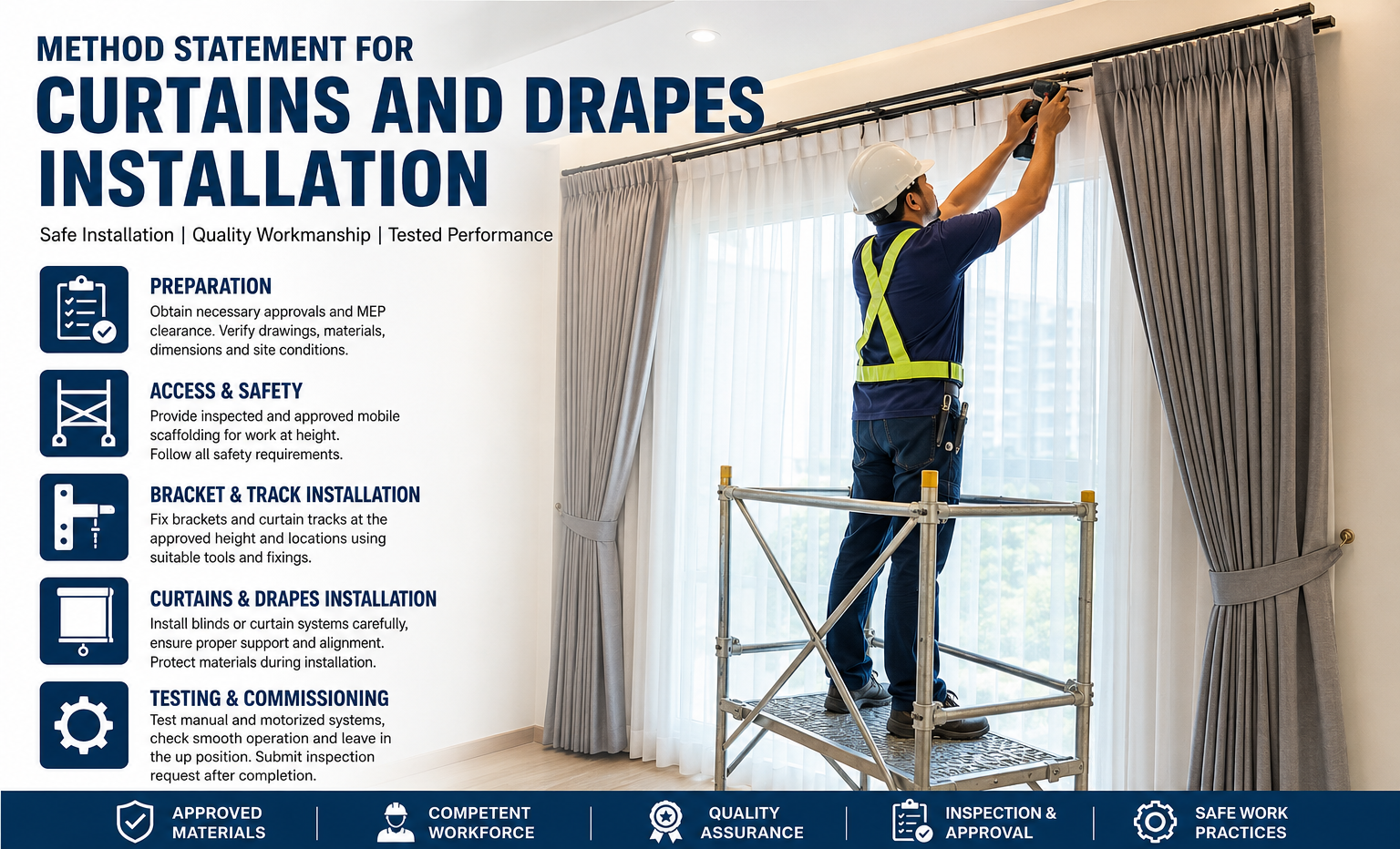
Once the brackets have been inspected, each blind shall be lifted carefully into position by sufficient operatives. At least one operative shall support the blind assembly at all times during positioning and fitting.
The blind shall be engaged with the brackets using the manufacturer’s specified procedure. Power tools shall not be used to force the blind into the brackets or to complete the engagement where the manufacturer requires manual fitting.
The installer shall verify that the blind is properly seated, supported, and aligned before releasing it. The operating mechanism, fabric alignment, and clearance from adjacent finishes shall then be checked.
Where necessary, the protective wrapping shall remain in place after installation to prevent damage from dust, paint, cleaning activities, and other trades.
Protective covers shall not obstruct required inspections or conceal defects that must be checked before acceptance.
7.5 Installation of Motorized Blinds and Controls
Motorized blinds shall be installed in coordination with the electrical and control-system teams.
Before testing, the installation team shall verify that the motor, brackets, control accessories, and other components are correctly installed. Electrical connections shall be completed only by authorized personnel in accordance with the approved electrical drawings and applicable safety procedures.
The following items shall be checked, as applicable:
- Motor compatibility with the installed blind.
- Correct connection of the approved power supply.
- Control switch, remote control, or automation interface.
- Cable routing and protection.
- Manufacturer-specified travel limits.
- Obstructions along the operating path.
- Accessibility for maintenance and future servicing.
The system shall not be energized until the required electrical checks and approvals have been completed.
7.6 Installation at Height
Where installation is required above the safe working height of secured steps, mobile scaffolding or another approved access system shall be provided. A project-specific height threshold, including a 3 m threshold where specified in the work procedure, shall be applied in accordance with the approved risk assessment and access-equipment requirements.
Mobile scaffolding shall be inspected and approved by the designated competent person or safety officer, as required by the project procedure, before use. The required inspection record or inspection request shall be submitted and accepted before work starts.
The following precautions shall be observed:
- Scaffolding shall be erected and used by competent personnel.
- Platforms shall be fully decked and provided with required edge protection.
- Wheels shall be locked before work begins.
- The platform shall be used within its rated capacity.
- Personnel shall not climb on guardrails or use improvised extensions.
- Scaffolding shall not be moved while occupied.
- The integrity of the platform shall be rechecked after each relocation.
- Tools and materials shall be secured against falling.
- The area below the work shall be controlled where there is a risk of falling objects.
Where the work area is restricted or has finished flooring, suitable floor protection shall be installed before access equipment and materials are brought into the area.
Work shall stop if the access equipment becomes unstable, damaged, or otherwise unsafe.
8. Inspection and Quality Control
Quality inspections shall be conducted throughout the installation process and after completion.
The site engineer and QA/QC engineer shall verify that the installation complies with the approved drawings, material submittals, project specifications, and manufacturer requirements.
Inspection points shall include:
- Correct material type, color, size, and model.
- Correct installation height and location.
- Bracket spacing and fixing security.
- Track alignment and stability.
- Blind seating and support.
- Curtain and drape alignment.
- Fabric condition and cleanliness.
- Smooth movement of manual systems.
- Correct operation of motorized systems.
- Proper control operation and travel limits.
- Protection of surrounding finishes.
- Completion of outstanding snags.
Any nonconforming work shall be recorded and rectified before the relevant inspection is offered for acceptance.
9. Testing and Commissioning
After the installation is complete, the curtains, drapes, and blinds shall be inspected and functionally tested.
Manual systems shall be operated through their intended range of movement to verify smooth operation, secure support, and the absence of obstructions.
Motorized systems shall be tested in accordance with the manufacturer’s instructions and approved project requirements. The test shall verify the operation of the motor, control devices, travel limits, and relevant automation functions, where provided.
Once testing has been completed, protective wrapping shall be removed when appropriate and the fabric and finished surfaces shall be checked for damage or contamination.
Where further construction activities are taking place, the blinds shall be left in the raised position, where applicable, to minimize disturbance and protect the fabric.
Completed works shall be cleaned using suitable methods recommended by the manufacturer. Any damage identified during testing shall be reported and rectified.
10. Health, Safety, and Environmental Requirements
All personnel shall comply with the approved project HSE plan, risk assessment, and applicable site safety procedures.
The main safety requirements include:
- Wearing appropriate personal protective equipment.
- Maintaining good housekeeping and clear access routes.
- Using inspected tools and suitable access equipment.
- Preventing unauthorized access beneath overhead work.
- Checking concealed services before drilling.
- Handling long tracks and blind assemblies safely.
- Avoiding excessive manual lifting and awkward postures.
- Keeping fabrics and packaging away from hot work and other hazards.
- Collecting packaging and waste for disposal in designated areas.
Electrical work on motorized systems shall be performed by authorized personnel using the required isolation and verification procedures.
Any unsafe condition shall be reported immediately, and the affected activity shall remain suspended until appropriate corrective measures have been implemented.
11. Final Inspection and Handover
Upon completion, the installation team shall remove waste materials, clean the work area, and ensure that the completed installation is protected from subsequent construction activities.
The QA/QC engineer shall submit the inspection request for the completed curtains, drapes, or blinds and obtain the required inspection approval.
Any comments raised by the consultant or engineer shall be addressed before final acceptance.
The handover documentation shall include the applicable inspection records, test results, approved material information, manufacturer instructions, and operation and maintenance information for motorized systems.
The completed installation shall be handed over in a clean, secure, properly aligned, and fully operational condition.
12. Conclusion
This Method Statement for Curtains and Drapes Installation establishes a systematic approach to installing manual and motorized window-covering systems while maintaining safety, quality, and protection of completed finishes.
Compliance with approved drawings, manufacturer recommendations, access-equipment requirements, MEP coordination procedures, and inspection requirements will help ensure a reliable installation and satisfactory final appearance.
All installation and testing activities shall be completed by competent personnel and offered for inspection and approval in accordance with the project’s quality management procedures.